


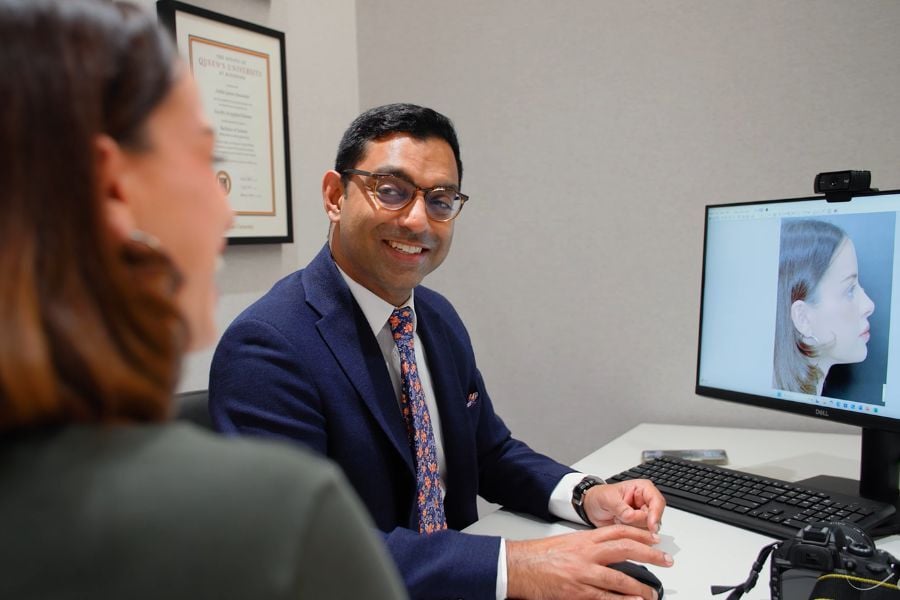
Meet Dr. Ashlin Alexander, Facial Cosmetic Surgeon at HealthOne Skin Clinic at The Well. He is registered with the CPSO, specializing in Otolaryngology-Head & Neck Surgery. Widely known for his natural approach to the face, Dr. Alexander has extended his practice to offer surgical consultations at HealthOne. He brings expertise in both surgical and non-surgical aesthetic care, including rhinoplasty, eyelid surgery, brow lifts, face and neck lifts (deep plane face and neck lift), hair transplantation and injectables.
Across his work, Dr. Alexander’s approach is customized, thoughtful and centered on each patient’s needs. Whether someone is considering surgery, a non-surgical treatment, or simply wants to better understand their options, he focuses on creating a plan that is safe, natural-looking and aligned with their goals.
We asked Dr. Alexander to share how aesthetic medicine is changing, what patients should know before getting Botox or filler, and why subtle results still require careful planning.
What Aesthetic Trends Are You Seeing Right Now?
Aesthetic medicine is always evolving, especially in the non-surgical space. Trends shift over time, and what patients are asking for now is different from what many people were asking for a few years ago.
One of the biggest shifts I’m seeing is that patients are asking for more conservative changes. Before, there was more interest in larger, full-face filler treatments. Now, many patients are looking for subtler results or treatments that are more preventive.
That includes Botox or other neuromodulators for wrinkles, good skincare, laser resurfacing, PRP for the face, and more conservative filler when it’s appropriate.
I still think filler can be a very good treatment if it’s done carefully, safely, and for the right patients. My own approach has always been conservative, so in that sense, my philosophy hasn’t changed. The goal isn’t to make someone look different. The goal is to help them look refreshed and balanced in a way that still feels like them.
I’m also seeing more interest in the neck, jawline, and lower face. On the surgical side, more patients are asking about face and neck lift surgery, eyelid surgery, brow lifts, and other anti-aging procedures. A lot of that interest is influenced by social media, media coverage, and celebrity conversations around natural-looking results.
Why Are More Patients Asking for Natural-Looking Aesthetic Treatments?
Patients are more aware than ever of what can happen when treatments are overdone. Social media has played a big role in that.
There was a period when social media was driving people toward more dramatic treatments, such as very sharp jawlines, larger lips, or a “more is more” approach to filler. More recently, the conversation has swung too far in the opposite direction, with some influencers and online conversations making people feel like filler is always bad.
The reality is more nuanced. Filler isn’t inherently bad, but problems can happen when it’s overused, placed poorly, or just isn’t the right treatment for that patient. When filler is used carefully, conservatively and by a practitioner who has a strong understanding of anatomy, it is really a very effective option.
Patients are more cautious now, and many are asking for treatments that are subtle or preventative. That can be a good thing, but the treatment still needs to fit the individual. Sometimes the right answer is to do less. Sometimes the right answer is skincare, laser, Botox, or a combination of treatments. And sometimes a conservative, appropriate amount of filler can be exactly the ideal treatment.
The goal is to make the right recommendation for the patient, not to follow a trend. That’s always how we’ve practiced aesthetic medicine from Day 1. It’s our standard approach that has stood the test of time.
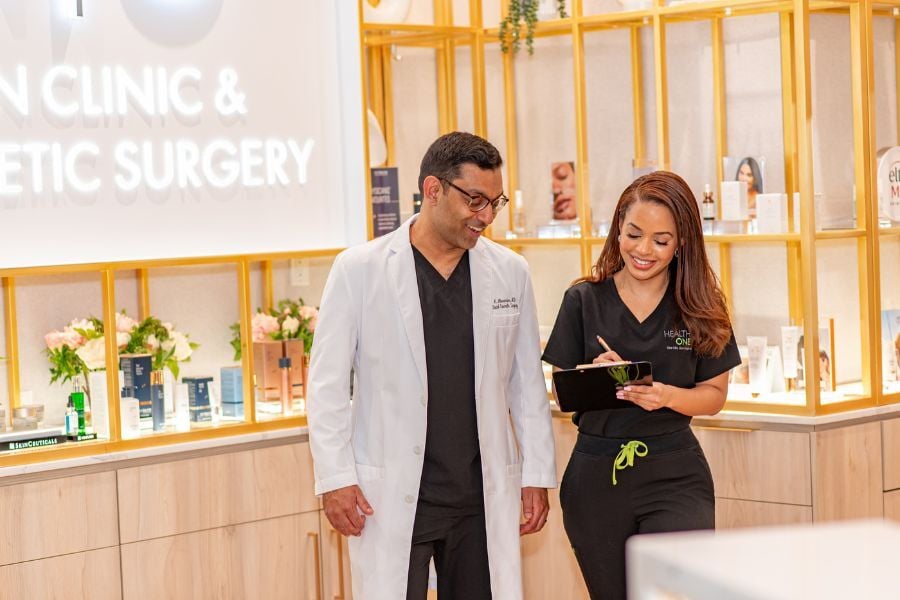
How Does Social Media Change the Consultation Conversation?
Social media has made patients more informed, but it can also make aesthetic decision-making more confusing.
Patients often come in having seen before-and-after photos, celebrity images, or influencer content. That can be helpful as a starting point, but it doesn’t always provide the full context. Lighting, angles, filters, and editing can all change how results appear.
Social media can also create strong opinions about treatments. A few years ago, many patients were asking for more filler because that was the trend. Now, some patients are worried that all filler is harmful or unnatural because the conversation has shifted so strongly in the other direction.
That’s where education matters. It gives us a chance to talk about what the patient is actually trying to achieve, what’s realistic, what’s safe, and what treatment, if any, makes sense for their anatomy.
Aesthetic treatments should always be individualized. What looks good on one person, or what works for one face, may not be the right choice for another. This is why I always spend time getting to know my patient and understanding their goals before proceeding with any treatment.
What Should Patients Know If They Are Worried About Filler?
Filler isn’t automatically a bad treatment, but it does need to be used carefully.
The issue is usually not filler itself. The issue is how much is used, where it’s placed, and whether it’s the right treatment for that patient. Too much filler or poorly placed filler can create results that look unnatural or lead to problems. But when filler is used judiciously, it can help restore balance, support facial structure, or create subtle changes.
It’s also important to know that filler isn’t always the answer. Sometimes Botox, skincare, laser resurfacing, or simply waiting may be the better option. In some cases, surgery may be more appropriate than trying to use filler to achieve something it can’t realistically do.
A good provider should be comfortable explaining not only what filler can do, but also its limitations and alternatives. That conversation should also allow patients to ask why a treatment is being recommended, what to expect, and whether there are other options.
One of the advantages of being a Facial Plastic Surgeon is that I’ve got both surgical and nonsurgical tools in my toolbelt, and at HealthOne we’ve got aestheticians and physicians specialized in the skin. So I can customize treatment plans and offer the full range of recommendations and solutions for each patient. That’s a truly powerful advantage.
Are You Seeing More Patients Looking to Correct Filler or Treatments They Had Elsewhere?
Because I’m a surgeon who also does injectables, I’ve always had patients come in looking to address treatments they had elsewhere and didn’t love, or treatments that caused issues for them.
With filler concerns, the first step is usually to understand what was done and where the product may have been placed. Sometimes that means using imaging, such as an ultrasound assessment, if we need more information.
If filler needs to be dissolved, I usually take a slow and careful approach. It’s not about rushing to dissolve everything at once. We want to avoid creating new problems. The goal is often to get the patient back to their natural baseline and then reassess from there.
Once we are back to a clean starting point, we can decide whether the patient needs any filler at all. Sometimes they don’t. Sometimes they may benefit from a very small amount in a specific area. Sometimes a surgical solution is the best option. The key is to take a thoughtful, gradual approach.
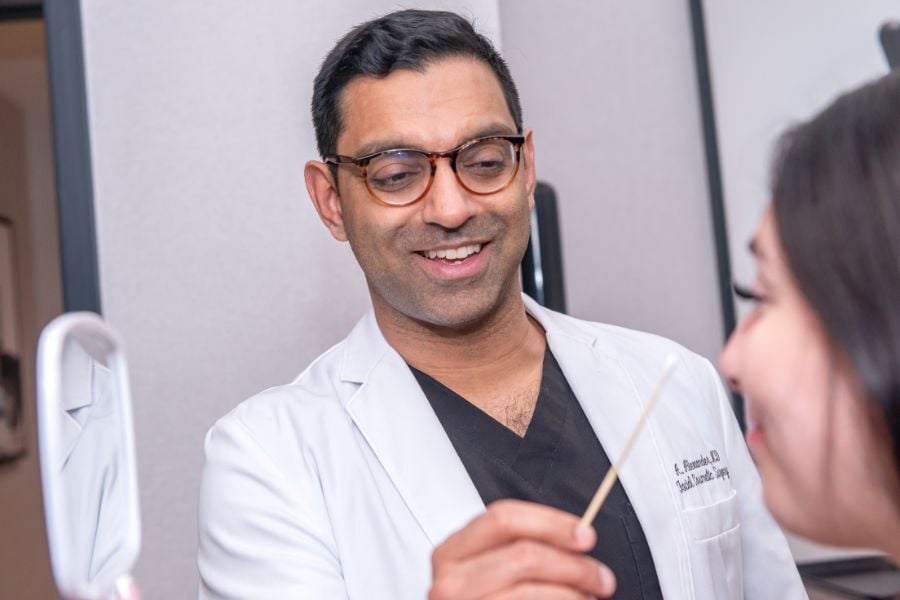
What Is Injectable Rhinoplasty and Why Does It Require Specialized Expertise?
Injectable rhinoplasty is a non-surgical treatment that uses filler to make subtle changes to the appearance of the nose. While it may seem like a simple treatment, the nose is one of the most complex areas to inject.
My experience performing surgical rhinoplasty gives me a clear understanding of nasal anatomy, proportion, and what filler can realistically achieve. I can visualize with my mind’s eye exactly what the anatomical structure is underneath the skin, kind of like X-ray vision. That’s super critical for being able to provide great results.
Liquid rhinoplasty can be a great treatment for the right patient, but it isn’t for everyone, and it isn’t something every injector knows how to perform.
The nose is a complex area, and safety matters. Injectable rhinoplasty can be really amazing at addressing certain concerns: smoothing the appearance of a small bump and counteracting the look of a droopy tip on a side profile or making a flat bridge look more refined on a front view. But it can’t actually make the nose physically smaller, correct every concern, or improve breathing function. Injectable rhinoplasty cannot replace surgery when surgery is the more appropriate option.
What Cosmetic Trends Concern You Right Now?
I think patients are generally becoming more educated, which is a good thing. I’m not seeing as many people asking for extremely dramatic injectable treatments as we might have seen a few years ago.
That said, there are still patients who want too much lip filler, and that’s something injectors need to manage carefully. Lips can be overfilled, and the best results usually come from exercising restraint.
I also think patients should be cautious about jumping too quickly into certain trends, including radiofrequency skin tightening, energy-based treatments, biostimulatory treatments and threads. These treatments can have a role, but they aren’t risk-free, and they aren’t right for everyone.
When problems happen, it can be because a treatment creates lumps, irregularities, or too much scar tissue. That can become especially important if a patient later decides to have surgery, such as a facelift or neck lift, because scar tissue can make the procedure more complicated in those cases.
Like anything in aesthetic medicine, it’s better to move carefully, understand the risks, and choose treatments based on the patient’s anatomy and goals rather than jumping on the latest trend.
How Does HealthOne’s Integrated Care Model Support Aesthetic Patients?
One of the great things about HealthOne is that there are multiple providers with different areas of expertise, which allows us to collaborate on a patient’s care.
In aesthetic medicine, patients often benefit from looking at the full picture rather than focusing on one treatment. For example, a patient may come in asking about Botox or filler, but after a full assessment, we may also talk about skincare, laser treatments, acne care, or future surgical options.
At HealthOne, that patient can be connected with other providers who can support different parts of the care plan. A medical aesthetician may help with medical-grade skincare or customized skin treatments. A physician practicing in dermatology may help with acne or medical skin concerns.
That kind of collaboration helps patients receive more thoughtful, well-rounded care. It’s not about doing one treatment in isolation. It’s about building a plan that makes sense for the patient. This is a real advantage at HealthOne: we can provide comprehensive treatment plans across all aesthetic medicines, which is ultimately best for the patient.
When Should Someone Book a Consultation at HealthOne?
A consultation is a good first step if you’re considering Botox, filler, injectable rhinoplasty, facial balancing, skin treatments, or facial surgery and want to understand what’s right for you.
It’s also helpful if you’ve had filler or another treatment elsewhere and are unhappy with the result, or if you’re unsure whether a treatment you’ve seen online is safe or appropriate for you.
At HealthOne The Well, consultations with Dr. Alexander are focused on education, safety and individualized treatment planning. The goal is to help patients understand their options and make decisions that feel right for them.
About Dr. Ashlin J. Alexander
MD, FRCSC
Otolaryngology-Head & Neck Surgery, practising in Facial Plastic and Reconstructive Surgery | Aesthetic Injector
Dr. Ashlin Alexander is widely known for his natural approach to Facial Plastic Surgery. As one of the most sought-after doctors in Toronto, he is thrilled to be extending his practice to offer surgical consults at HealthOne The Well. Dr. Ashlin provides a patient-centric approach and is meticulously skilled in both surgical and non-surgical solutions, including rhinoplasty, eyelid surgery, brow lifts, face and neck lifts, and hair transplantation. His approach is customized, thoughtful, and always centered around the needs of the patient. Alongside his team of industry experts, Dr. Ashlin looks forward to expanding his practice and providing HealthOne patients with brilliant aesthetic results.




 Back to Main Blog

